On-chain Perpetual Trading
On-chain perpetual trading allows traders to open leveraged long or short positions on crypto assets without an expiry date, with all execution, settlement, and margin management handled by smart contracts on a blockchain. Unlike centralized exchanges, on-chain perp DEXs like Carbon offer self-custody, transparent pricing, and permissionless access, while using solver-based execution to source liquidity from major exchanges including Binance and Bybit.
What Are Perpetual Futures?
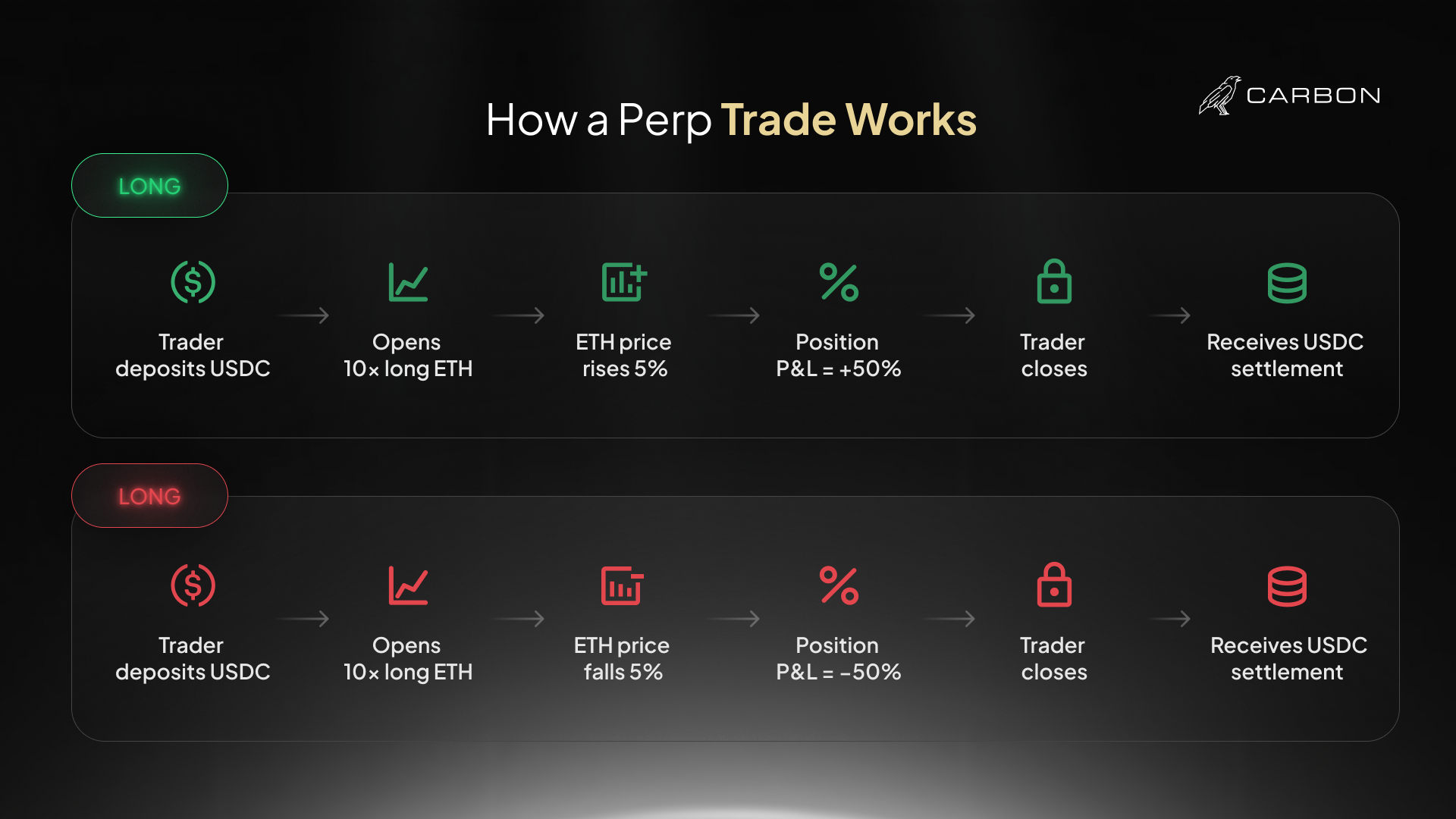
A perpetual future — or “perp” — is a derivative contract that lets you go long or short on an asset with leverage, without an expiry date. Unlike dated futures, you can hold a perp position indefinitely, as long as your margin holds and funding costs don’t erode it.
Perps were invented by BitMEX in 2016 and became the dominant instrument for crypto trading within five years. They now represent the majority of global crypto trading volume across both centralized and decentralized venues. The instrument is straightforward: you put up collateral, open a position, and your profit or loss is the difference between entry and exit price, scaled by leverage.
Two mechanisms make perps work.
Funding rates keep the perp price tethered to the underlying spot price. If the perp trades above spot, longs pay shorts a periodic funding payment. If the perp trades below spot, shorts pay longs. This continuous incentive mechanism prevents sustained divergence between the perp price and the asset it tracks.
Margin is the collateral you post to keep your position open. If your position moves against you and your margin falls below the maintenance threshold, the protocol liquidates your position and uses your collateral to cover losses. This protects the counterparty and keeps the system solvent.
How On-chain Perps Differ From CEX Perps
The mechanics of a perpetual contract are identical whether you’re trading on Binance or on Carbon. What changes is who controls the infrastructure and what happens to your money.
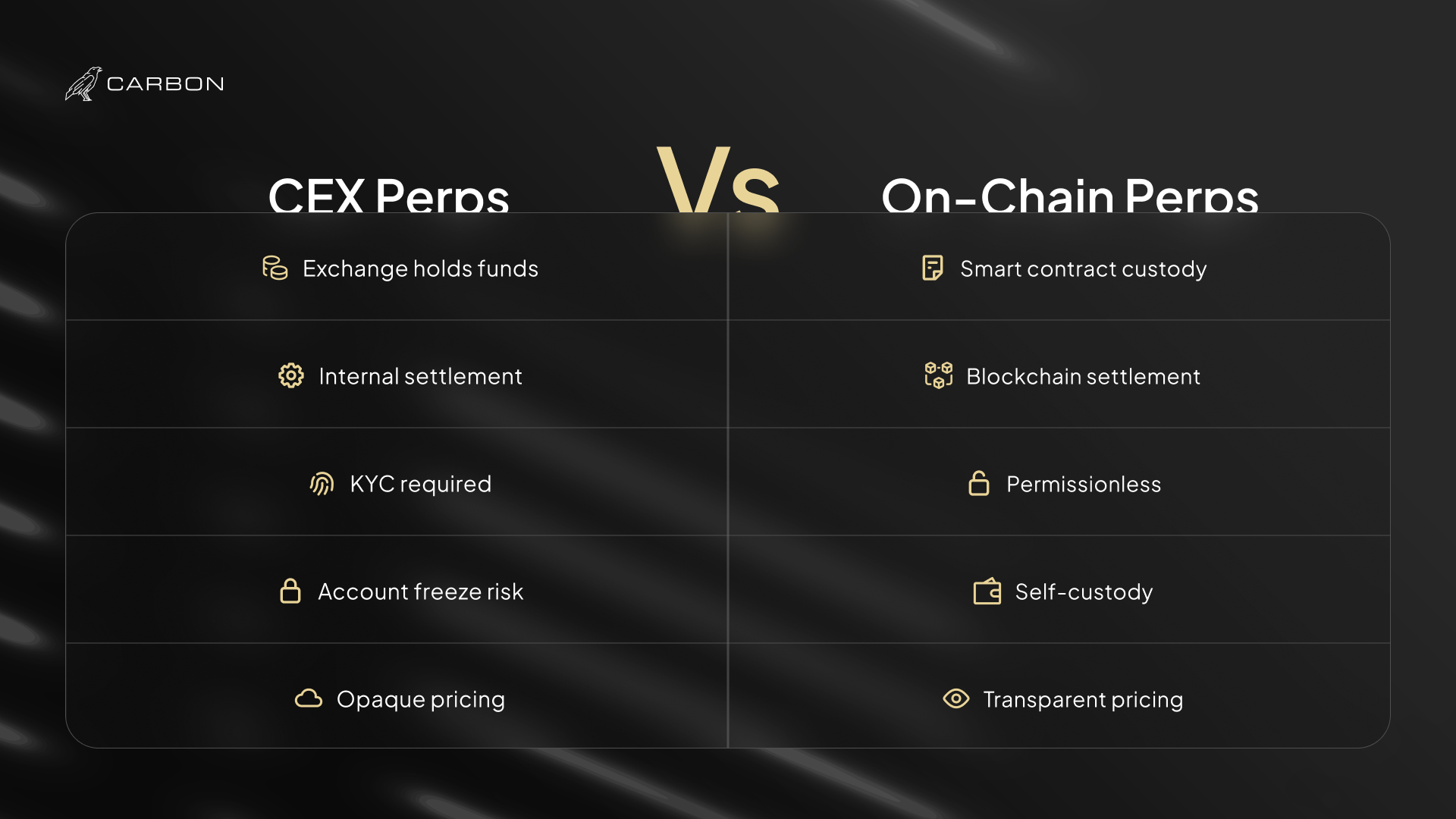
On a centralized exchange (CEX):
-
The exchange holds your collateral. If the exchange fails, gets hacked, or freezes withdrawals, you lose access to your funds. This is what happened to FTX users in November 2022.
-
The exchange is your counterparty or brokers your trades internally. You trust that the matching engine is honest and that prices are not being manipulated.
-
Account creation requires KYC. Geographic restrictions apply. The exchange can close your account or freeze withdrawals at any time.
-
Settlement is internal. Your P&L sits on the exchange’s balance sheet until you withdraw.
On a decentralized perp exchange (DEX):
-
Your collateral is held in smart contracts, not by a company. No exchange can freeze your funds or block withdrawals.
-
Settlement is on-chain. Every trade, position, and liquidation is recorded on a public blockchain and auditable by anyone.
-
Access is permissionless. A wallet and an internet connection are all you need. No KYC, no account approvals, no geographic blocks enforced at the platform level.
-
Execution is transparent. You can verify your fill price, funding rate, and margin calculation independently. There is no information asymmetry between you and the exchange.
The tradeoff has historically been liquidity. CEX perp books are deeper. CEX fills are faster. On-chain infrastructure handles lower throughput and introduces settlement finality that CEX execution doesn’t have. This gap is closing rapidly. Solver-based execution is the primary reason why.
Execution Models: Three Approaches
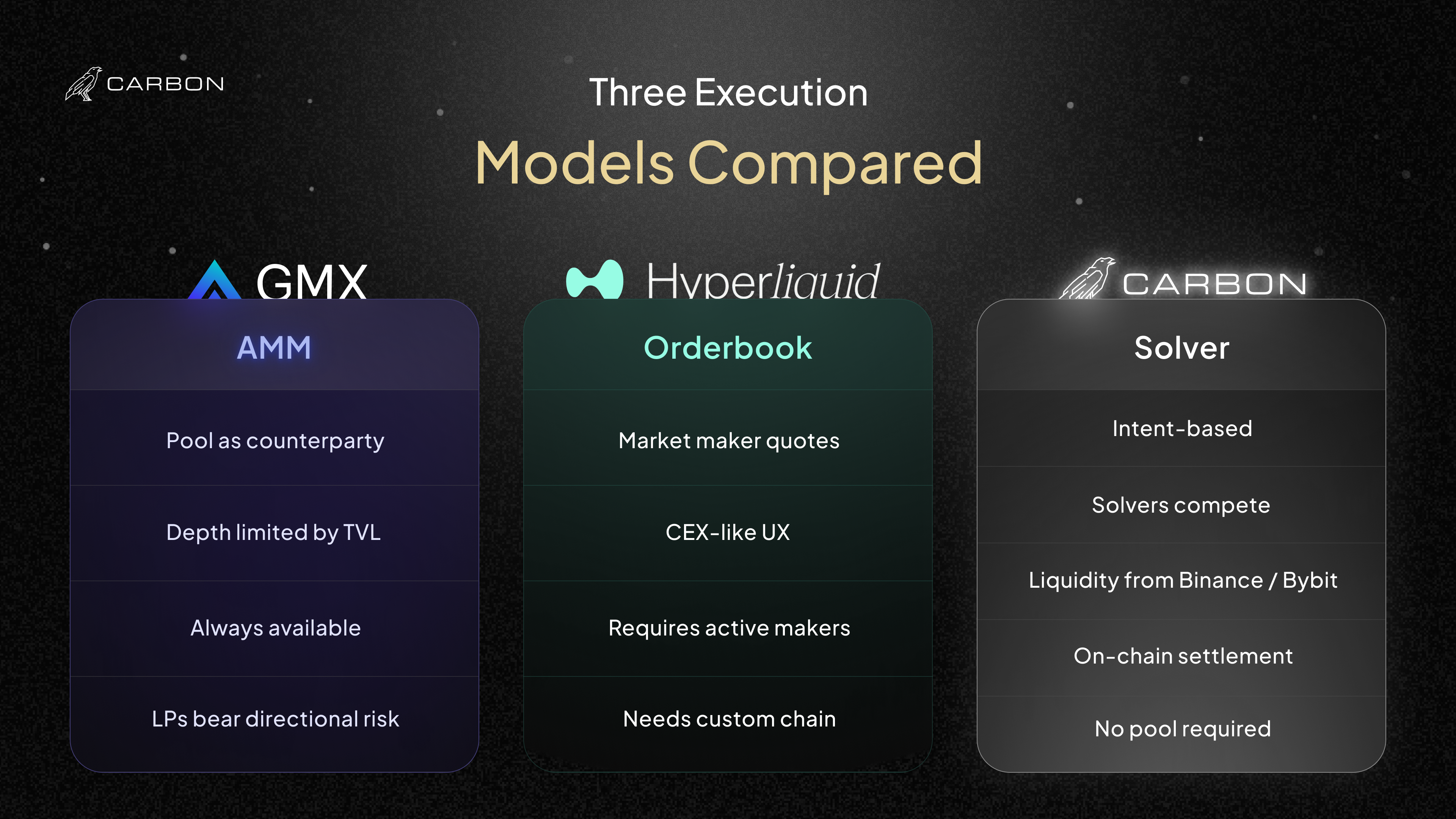
Not all perp DEXs work the same way. The execution model determines how your order gets filled and where the liquidity comes from. Three dominant models exist in the current market.
AMM-Based Liquidity (GMX-style)
AMM-based perp DEXs use liquidity pools where LPs deposit assets to act as the collective counterparty for all trades. When you go long ETH with 10x leverage, the LP pool takes the other side of that trade.
The advantage is simplicity: no orderbook, no matching engine, no dependency on active market makers. LPs earn fees regardless of market conditions. The pool is always available.
The limitation is depth. Your execution quality is bounded by how much capital is in the pool. Large trades cause significant price impact. Listing new assets requires dedicated pool capital. When traders are consistently profitable, the pool absorbs the losses directly. This directional risk for LPs limits how aggressively they can fund pools on volatile or less liquid assets.
On-chain Orderbooks (Hyperliquid-style)
Orderbook DEXs replicate the CEX experience on-chain. Market makers post resting bids and asks. Taker orders match against the book. Price discovery happens through the orderbook, not through a formula.
The advantage is that orderbook platforms feel familiar to traders from CEX environments and can achieve tight spreads with active, well-capitalized market makers. Hyperliquid has demonstrated this model can achieve genuine CEX-quality execution on major pairs.
The limitation is that running a high-throughput orderbook on a general-purpose blockchain is technically demanding. Every order, cancel, and modification is an on-chain event. High-frequency market making is not economically viable with high gas costs and slow finality, which is why Hyperliquid built a purpose-built L1 and dYdX v4 migrated to Cosmos.
Solver-Based Execution (Carbon-style)
In the solver model, traders don’t submit orders to a pool or a book. They submit intents — signed statements expressing what trade they want at what terms. Professional market makers called solvers receive these intents and compete to fill them.
Solvers source their quotes from external venues: Binance, Bybit, OKX, and institutional broker connections for non-crypto assets. When a solver fills your trade, they simultaneously hedge their position on those external venues. The result is that your execution quality reflects real market depth from major exchanges, not the depth of an on-chain pool or book.
Settlement still happens fully on-chain. The solver’s hedging is off-chain, but your margin, position, and P&L are managed by smart contracts on Arbitrum. CEX-quality execution. Self-custodial settlement.
Funding Rates, Margin, and Liquidation On-chain
The mechanics of these three elements don’t change in an on-chain context. The implementation does.
Funding rates in on-chain perps are computed using the difference between the mark price (derived from an index of external prices) and the perp price. Payments happen automatically between long and short positions at set intervals, typically every hour or every eight hours depending on the platform. No action is required from the trader — funding is applied to the position automatically.
Margin on Carbon is denominated in USDC. You deposit USDC as collateral, open a leveraged position, and the smart contract tracks your margin ratio in real time. Your maintenance margin requirement determines when liquidation triggers. If your margin ratio falls below this threshold, your position is eligible for liquidation.
Liquidation on-chain is handled by liquidator bots that monitor open positions and trigger liquidations when margin ratios fall below thresholds. These bots are incentivized by a portion of the liquidated collateral. The process is fully transparent: every liquidation is an on-chain transaction visible to anyone with a block explorer.
The State of On-chain Perps Today
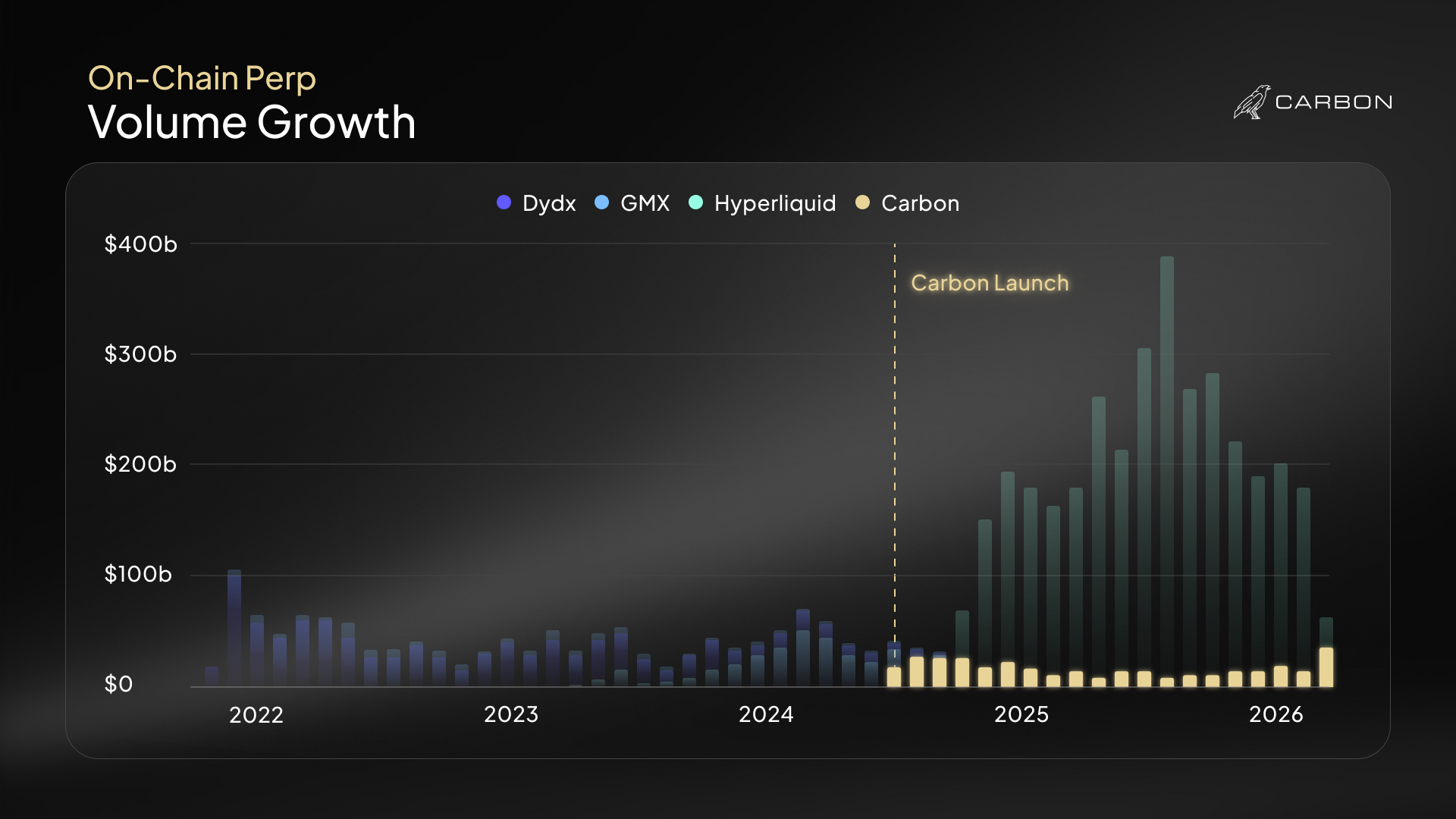
On-chain perpetual trading has grown from a niche experiment to a significant portion of global derivatives volume. Monthly volume across perp DEXs regularly exceeds $100 billion, and the trend is structural rather than cyclical.
Platforms like Hyperliquid have demonstrated that on-chain execution can match CEX UX when the infrastructure is purpose-built. GMX and Gains Network showed that LP-based models can sustain billions in TVL and generate real fee revenue. dYdX proved that institutional traders will use on-chain venues when the execution quality is there.
Carbon enters this market with a specific differentiator: solver-based execution that sources liquidity from major CEXs, applied to the broadest pair coverage of any perp DEX. 550+ crypto pairs at launch, with CFD markets across stocks, forex, indices, and commodities to follow.
Why Traders Are Moving On-chain
The FTX collapse in November 2022 was the most significant catalyst. When FTX filed for bankruptcy, billions in user funds became inaccessible overnight. Traders who had left collateral on the exchange lost access to their positions and their money. Many never recovered it.
That event crystallized the custodial risk that had always existed on CEXs but had never been tested so dramatically. On-chain perp volumes spiked immediately after and have sustained a higher baseline. The underlying reasons are structural.
Self-custody means your collateral is in smart contracts, not a company’s balance sheet. No exchange failure, regulatory action, or unilateral decision can take it from you.
Transparency means you can verify every trade, every funding payment, and every liquidation. There is no information asymmetry between you and the exchange. Pricing is on-chain and auditable.
Permissionless access means no account approvals, no KYC blocking you from certain features, no geographic restrictions enforced at the platform level. A wallet and a connection are all you need.
Censorship resistance means no single entity can block your positions, freeze your collateral, or delist an asset you’re holding. The smart contract doesn’t have an account closure button.
These properties don’t disappear when markets are calm. They matter most when conditions deteriorate. That’s when the difference between a CEX account and a self-custodial on-chain position becomes real.
How Carbon’s On-chain Perps Work
Carbon offers 550+ crypto perpetual pairs with up to 75x leverage, zero trading fees, and CEX-depth liquidity sourced through a solver network connected to Binance, Bybit, and other major venues.
You deposit USDC as collateral. You select a pair and leverage, and submit your trade. The Carbon solver network fills your order at the best available price, sourcing quotes from major exchanges in real time. Your position is held in a smart contract on Arbitrum. Funding is applied automatically at each interval. If your margin falls below the maintenance threshold, liquidation bots close the position and return remaining collateral.
Zero fees means exactly that: no maker fees, no taker fees. Revenue comes from the solver spread, not from platform fees. The economics work differently from a traditional exchange, and the trader benefit is direct.
The 550+ pair coverage is not achievable with an LP pool model. You can’t fill a vault with enough dedicated capital for each pair. Carbon’s solver model doesn’t require per-pair pool capital. Every pair draws from the same solver network, which connects to the deep markets that already exist on major CEXs. Adding pairs is a routing question, not a capital deployment question.
Start Trading
Carbon’s on-chain perp DEX is live. Trade 550+ crypto perpetual pairs with zero fees and up to 75x leverage.